

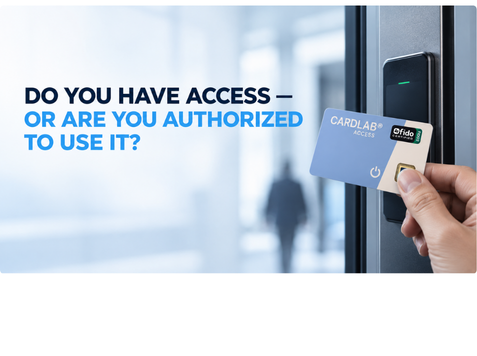
🔐 DO YOU HAVE ACCESS — OR ARE YOU AUTHORIZED TO USE IT?

Denmark has just experienced a major security incident.
Approximately 8.8 million Danish personal identification numbers (CPR numbers), together with names and addresses, were accessed by unauthorized parties.
But there is an important detail:
This was not a classic cyberattack.
According to Danish authorities, unauthorized individuals misused a private company's legitimate access to Denmark's national CPR system.
The access was valid.
The system accepted it.
But the people using it were not authorized to do so.
And that exposes a cybersecurity challenge that reaches far beyond Denmark:
Having access is not the same as proving you are the person authorized to use it.
Passwords, PIN codes, credentials, tokens and access cards can be stolen, shared, copied or compromised.
Yet many security systems still authenticate the credential without sufficiently verifying the person behind it.
At CardLab Innovation, we believe access should be bound to the individual.
Our Access FIDO biometric smart card combines FIDO2-certified authentication with on-card biometric verification, helping ensure that a credential can only be activated by its authorized user.
The fingerprint stays securely on the card.
Biometric verification happens locally.
There is no central biometric database containing users' fingerprints.
This changes the fundamental security question.
Instead of simply asking:
🔑 “Do you have access?”
we can ask:
👤 “Are you the person authorized to use it?”
The recent incident in Denmark is a powerful reminder that protecting sensitive systems and data is not only about stronger passwords, more complex credentials or securing databases.
It is about securing the connection between identity and access.
For governments, healthcare, defense, law enforcement, financial institutions and critical infrastructure, knowing who is actually behind the access is becoming increasingly important.
So there is one question worth asking:
Do you know who has access to your most critical systems?
And perhaps even more importantly:
Can you verify that the person using that access is actually the person authorized to use it?
Access should not prove possession.
Access should prove identity.